Table of contents
Paris is still breaking tourist records, with hotel occupancy and average room rates pushed up by a packed calendar of exhibitions, concerts, and big-ticket events, and by travelers who now expect more than a bed and a postcode. In that crowded market, the most compelling addresses sell a feeling: a lobby that works like a neighborhood living room, a rooftop that turns into a private lookout, and a location that makes the city legible in minutes. The 13th arrondissement, long a gateway between historic Paris and the capital’s newer edges, has quietly become one of the smartest places to check in.
Why Paris’ 13th is suddenly a hotel sweet spot
Forget postcard Paris for a second, and you start to see why the 13th arrondissement has gained momentum with travelers who want the city’s energy without its bottlenecks. It is one of the capital’s most layered districts, where the Seine’s left bank meets a dense grid of neighborhoods, where Chinese and Vietnamese addresses sit alongside contemporary art spaces, and where new urban projects have changed the way visitors move. The headline attraction is often street-level: the “open-air gallery” of boulevard Vincent-Auriol, a stretch widely recognized for monumental murals, and the Bibliothèque François-Mitterrand area, whose modern skyline and wide esplanades feel closer to a European business capital than to Haussmann’s Paris.
But the decisive factor is connectivity, and the 13th delivers it in practical, measurable ways. Paris’ public transport system is among the most used in Europe, with the Île-de-France network counting billions of passenger journeys every year, and in the 13th those flows intersect efficiently. Lines 6 and 14, for instance, link the district to major hubs and visitor corridors, and line 14 in particular has been at the heart of the capital’s transport upgrades, prized for its frequency and speed. Add tramway links and bus corridors, and the arrondissement starts to function like a hinge: quick for the Louvre, quick for the Left Bank, and quick for the train stations that matter when Paris is a step in a longer itinerary.
This is why hotels here increasingly pitch themselves as “a city within the city”, not because they are isolated worlds, but because the neighborhood itself is complete. You can do mornings with bakery coffee and a river walk, afternoons with galleries or shopping, evenings with international food that does not require a reservation weeks ahead, and you can get back without a taxi calculation. For a three-day stay, that simplicity compounds: fewer transfers, fewer long detours, more time spent in places rather than on the way to them.
Inside the lobby: the new Paris social contract
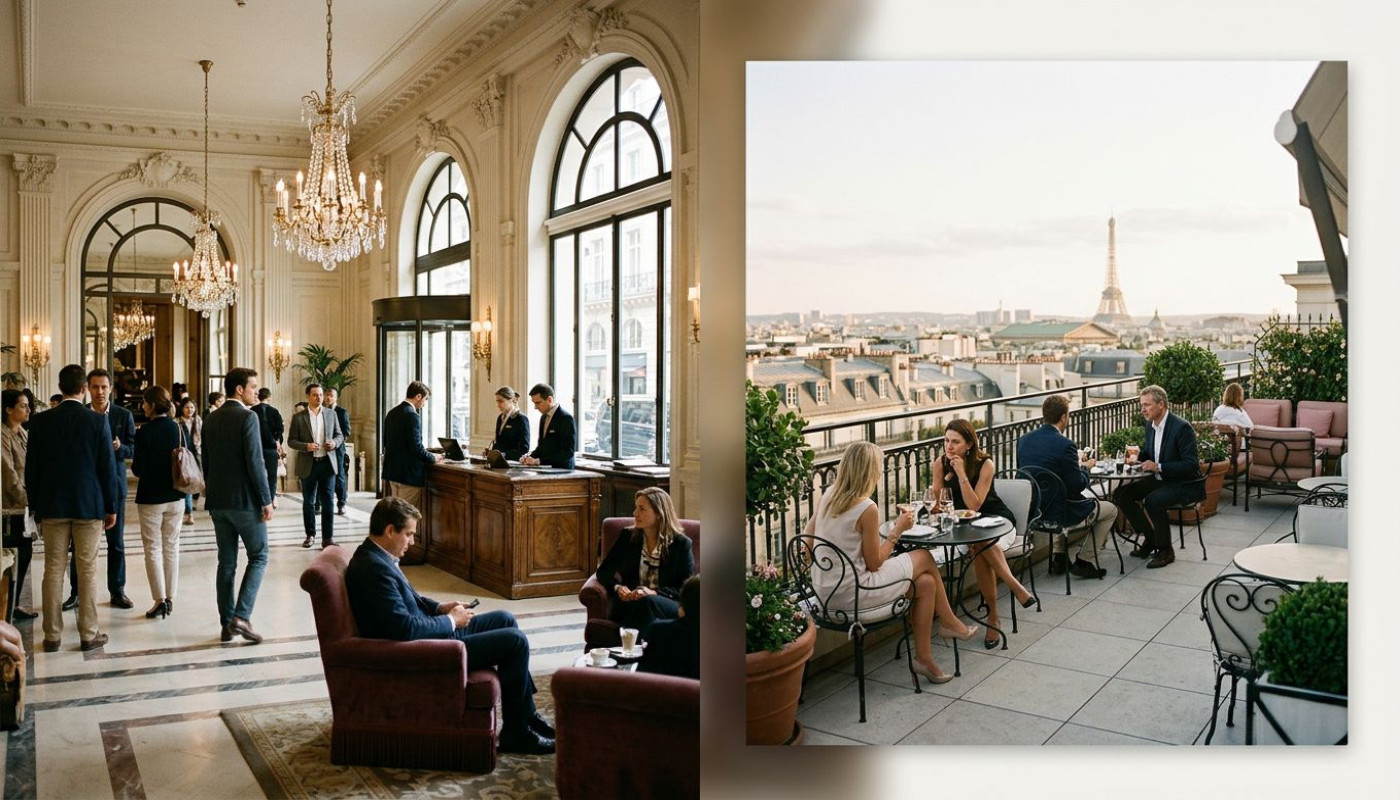
Walk into enough Paris hotels and a pattern appears: the lobby is no longer a corridor to the elevator, it is a statement about how the property wants guests to live. Some go theatrical, leaning into velvet and chandeliers, others mimic co-working spaces, betting that guests will linger if there is light, seating, and a sense of calm. This shift is not anecdotal; it tracks with broader changes in travel behavior, where a hotel is judged not only on room size, a perennial constraint in Paris, but on whether it offers a “third place” that feels useful, and even a little local.
That is where the idea of the legendary lobby has evolved, and why smaller, well-run properties can compete with famous names. A three-star hotel can create the same emotional payoff as a palace if it understands rhythm: how arrivals happen, where people pause after a day out, how a quiet corner can become an impromptu meeting spot, and how staff can guide without hovering. The best lobbies do not feel like set design, they feel like a lived-in room that happens to have a reception desk, and the tone matters because it shapes the rest of the stay, from the first question about directions to the last-minute request for a late checkout.
In the 13th arrondissement, this “social contract” between hotel and guest is sharpened by the district’s pace. People come here to move, and they also come here to pause, and a lobby that respects both is a competitive advantage. It is not only about comfort, but about information: the kind of quick, accurate advice that saves an hour, the transit tip that avoids a crowded interchange, and the restaurant suggestion that matches your schedule rather than chasing a trend. When hotels do this well, the building becomes a filter that makes Paris easier to read.
Urban Bivouac: a three-star base in Paris 13
Could a hotel be both practical and memorable? In the 13th arrondissement, Hotel Urban Bivouac Paris has leaned into that balance, positioning itself as a three-star address that aims to simplify the city while keeping a sense of character. The “bivouac” idea suggests a base camp, and for visitors who treat Paris like a sequence of neighborhoods rather than a checklist of monuments, that metaphor makes operational sense: you want a place that lets you set out early, return easily, and reset without friction. For many travelers, especially those arriving for a short break or for work, the value is in consistency, and three-star hotels that deliver it reliably can be the smartest choice in a market where prices fluctuate heavily by season and event calendar.
The other deciding factor is transport, and the property’s appeal rests on being close to public transit in a district designed for movement. In a city where travel time can define the day, proximity to métro and bus connections is not a footnote, it is a headline. Staying in Paris 13 also changes the geometry of a trip: the Left Bank is close, the river is close, and several of the city’s major stations and interchanges become straightforward rather than stressful. It is the kind of location that works for a first-timer who wants to “do everything” and for a repeat visitor who wants to avoid the thickest tourist corridors, and it is particularly relevant as Paris continues to adjust to rising demand, with travelers increasingly sensitive to both price and time.
Three-star positioning also brings clarity about what matters. You are paying for sleep quality, cleanliness, and a staff that can keep the machine running, and you are not paying for the grandeur tax. In the current Paris market, where even mid-range rooms can spike during major weeks, that transparency is part of the appeal, and it allows guests to reallocate budget to what they came for: museums, food, shows, and day trips. Hotel Urban Bivouac Paris fits into that logic as a functional base in a neighborhood that has enough life to feel Parisian, but enough breathing space to feel manageable.
From rooftops to metro lines: designing a stay
Paris sells a fantasy, but it is lived through logistics. The difference between a good trip and a great one often comes down to small decisions, and the smartest hotels now help guests make them. Rooftops, for instance, have become an urban symbol: not necessarily for parties, but for perspective, a quiet place to look across a city that can otherwise feel compressed at street level. When a property offers that kind of semi-private height, it changes the shape of an evening, and it can turn a “quick rest” into a moment that feels like part of the itinerary. Even without grand spectacle, the idea of a private rooftop is powerful because it delivers a Paris experience without the queue.
Yet the real backbone of any stay is still the commute, and the most valuable amenity in Paris remains access to public transport. Being near the métro and other lines is not glamorous, but it determines how much of the city you actually see, and how tired you are when you get back. Travelers who plan their days around one long cross-town transfer often end up skipping the last museum room, the last neighborhood stroll, or the late dinner they had imagined, and the cost is not only time, it is attention. A hotel in the 13th that is close to transit reduces that tax, and it makes it easier to build days by cluster: a morning on the Left Bank, an afternoon near the Seine, an evening in the east, and back again without bargaining with traffic.
There is also a broader trend at play: as cities push sustainability and as visitors become more conscious of their footprint, proximity to public transport becomes part of the value proposition, not just a convenience. Paris has encouraged alternatives to car travel for years, and tourists, especially those used to driving-heavy destinations, often discover that the métro is not only efficient but liberating. In that context, choosing a hotel such as Hotel Urban Bivouac Paris, in Paris 13 and close to public transport, can be read as a comfort choice and as a practical decision aligned with how the city increasingly wants to be visited.
How To Book And What To Budget
Book early for peak weeks, and compare flexible rates if your dates may shift, because Paris pricing moves fast around major events. In the 13th arrondissement, budgets can be more manageable than in the historic core, and a three-star option like Hotel Urban Bivouac Paris can leave room for museum tickets and dining. Check whether you qualify for transport passes or visitor discounts, and plan around métro access to cut daily costs.
Similar articles